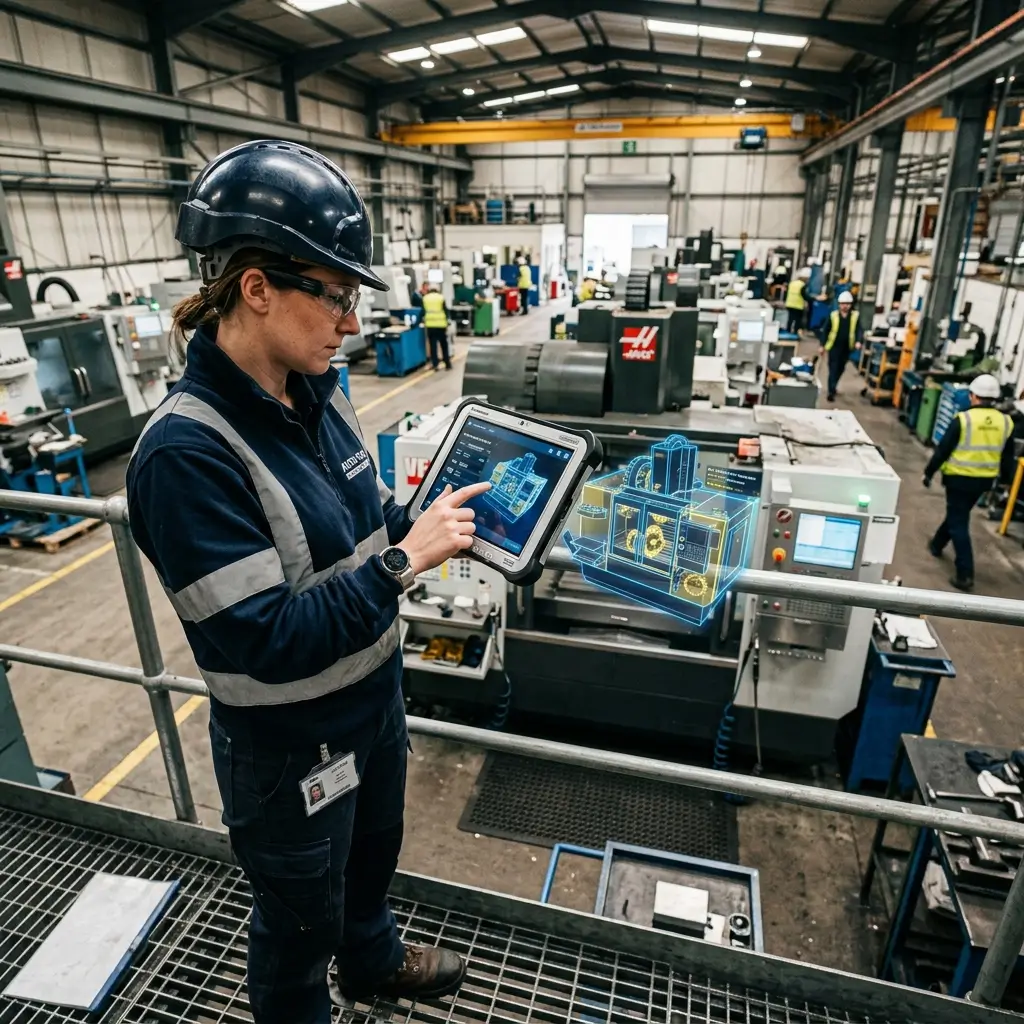
A digital twin is not just a dashboard showing live sensor data. It is a continuously updated, physics-informed simulation model that mirrors the state, behavior, and history of a physical asset or process in real time. In manufacturing, where downtime can cost $22,000 per minute on an automotive assembly line, the predictive and optimization capabilities of mature digital twins have a measurable ROI that dwarfs the implementation cost.
Anatomy of a Production Digital Twin
A production-grade digital twin consists of three integrated layers: the data layer (real-time telemetry from IoT sensors, PLCs, SCADA systems, and ERP), the model layer (physics-based or ML-based simulation models that reproduce asset behavior), and the service layer (predictive maintenance APIs, what-if simulation interfaces, and optimization recommendation engines).
The model layer is what differentiates a digital twin from a monitoring dashboard. Statistical models trained on historical failure data enable Remaining Useful Life (RUL) prediction. Finite element simulation models enable stress and thermal analysis of components under varied operating conditions. Combining both with live telemetry produces predictions that are both accurate and explainable.
Predictive Maintenance: The Primary Value Driver
Unplanned equipment failure in manufacturing accounts for an estimated $50 billion in annual losses globally. Predictive maintenance programs enabled by digital twins have demonstrated 20-40% reduction in unplanned downtime, 10-25% reduction in maintenance costs, and 5-15% increase in equipment useful life — figures validated across automotive, aerospace, and semiconductor manufacturing case studies.
The technical pipeline for predictive maintenance involves time-series anomaly detection on sensor streams, feature engineering to extract degradation indicators (vibration FFT analysis, thermal gradients, oil viscosity trends), and survival analysis models that estimate failure probability distributions over time. Explainability of predictions is critical for maintenance crews who need to understand not just 'when will it fail?' but 'why?'
Process Optimization and Digital Thread
Beyond individual asset twins, enterprise manufacturing is moving toward digital thread — a continuous data linkage from design through manufacturing through field operation. When a component fails in the field, the digital thread traces back to the original CAD model, manufacturing process parameters, quality inspection records, and material certifications that characterize that specific unit.
This traceability is not just operationally valuable — it is increasingly mandated by automotive OEMs, aerospace standards (AS9100), and medical device regulations (21 CFR Part 11). The engineering investment in digital thread infrastructure pays dividends in recall response speed, root cause analysis efficiency, and regulatory compliance.
Key Takeaway
"Digital twins in manufacturing are maturing from pilot projects to production infrastructure. The organizations that are capturing the most value are those that moved beyond the monitoring-only use case into genuine simulation and optimization — using the twin not just to observe the present but to model the future."
Topics